
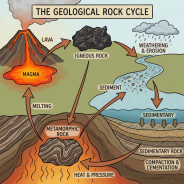
Beneath our feet, the Earth is never truly still. What seems solid and unchanging is constantly being broken down, reshaped, and rebuilt over time. Rocks crack under pressure, melt deep within the planet, and rise again in new forms. Mountains slowly crumble into sediment, while buried layers transform under heat and force. It's a process so gradual we rarely notice it, yet it never stops. The rock cycle is one of Earth's most enduring systems, quietly driving the transformation of the planet's surface. Igneous, sedimentary, and metamorphic rocks are all part of this continuous exchange, each shaped by different conditions but connected in an ongoing journey. What forms in fire can be worn away by wind and water, only to be compressed and changed once more beneath the surface. In this post, we'll take a closer look at how rocks move through this cycle of change, and how this process reveals the dynamic nature of the ground we often think of as permanent.
The rock cycle is the continuous process by which rocks are formed, broken down, and changed into different types over time. It explains how the three main types of rocks: igneous, sedimentary, and metamorphic, are connected and can transform into one another through natural processes. These transformations do not happen in a single direction. Instead, rocks move through a cycle driven by processes such as weathering, erosion, heat, pressure, melting, and cooling. Because of this, any type of rock can eventually become another type over time.
Igneous Rocks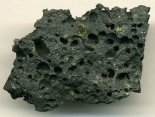
Igneous rocks form from molten material known as magma. Magma is hot, liquid rock that exists beneath the Earth's surface. It contains a mixture of melted minerals, dissolved gases, and crystals, and it plays a key role in the formation of new rock. When magma cools and solidifies, it forms igneous rock. This can happen either below the surface or after the magma reaches the surface. Intrusive igneous rocks form when magma cools slowly beneath the Earth's surface. Because the cooling process takes a long time, crystals have more time to grow, resulting in rocks with larger, visible crystals. Granite is a common example of an intrusive igneous rock. Extrusive igneous rocks form when magma reaches the surface as lava and cools quickly. Rapid cooling does not allow large crystals to form, so these rocks tend to have very small crystals or a smooth, glassy texture. Basalt is a typical example of an extrusive igneous rock.
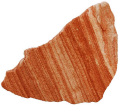
Sedimentary rocks form from the accumulation and compaction of sediments. These sediments are small pieces of rock, minerals, or organic material that come from the breakdown of existing rocks through processes like weathering and erosion. Once these particles are transported by wind, water, or ice, they settle in layers, often in places like rivers, lakes, and oceans. Over time, more and more layers build up, pressing down on the lower ones. This pressure, along with minerals that act like a natural cement, binds the sediments together into solid rock. This process is known as compaction and cementation. Sedimentary rocks often have visible layers and may contain fossils, which are preserved remains of plants and animals. Common examples include sandstone, limestone, and shale.
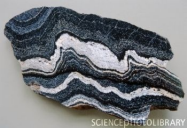
Metamorphic rocks form when existing rocks are changed by heat and pressure deep within the Earth. Unlike igneous rocks, they do not melt. Instead, the intense conditions cause the minerals inside the rock to rearrange, creating new textures and structures. This process, called metamorphism, can occur when rocks are buried beneath layers of other rock or when they are near tectonic plate boundaries where pressure and temperature are high. As a result, the original rock is transformed into a new type with different physical and chemical properties. Some metamorphic rocks develop a layered or banded appearance due to the alignment of minerals, while others remain more uniform. Common examples include marble, which forms from limestone, and slate, which forms from shale.
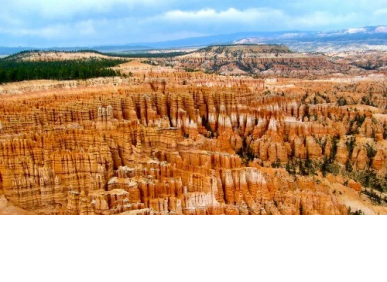
Rocks may seem solid and unchanging, but beneath the surface, Earth is always in motion. Mountains rise and crumble, rivers carry fragments of stone, and deep inside the planet, heat and pressure quietly transform rock into something new. These slow, powerful changes shape every landscape and leave traces that span millions of years. The rock cycle is a story of continuous transformation, a rhythm that reminds us nothing on Earth is truly permanent. Every grain of sand and every layered cliff tells a tale of fire, pressure, and time. It is a process that connects the past to the present, the surface to the depths, and one type of rock to another. In witnessing this quiet, unending transformation, we see the planet itself as a living system: dynamic, patient, and endlessly renewing.
